If you’ve ever traveled through Southern Italy or started researching Puglian architecture, you’ve almost certainly come across the word masseria.
Having spent the last seven years coming over here myself, and with Celsa visiting her family in the region since she was a kid—we’ve grown pretty familiar with the word. These days, you’ll see “masseria” tagged onto everything from rustic countryside ruins to ultra-luxury boutique hotels. But historically, a masseria served a very specific, hard-working purpose, and understanding that history has given us a whole new appreciation for the space we’re taking on.
Before we dive into the backstory of our own property, here’s a quick look at what these historic farmhouses actually were, why they were built, and how ours fits into the picture.
Fortresses of the Countryside
Historically, a masseria was a fortified country estate that functioned as a self-contained agricultural hub. Dating back as far as the Middle Ages and expanding right through the 16th to 19th centuries, these complexes were built to manage vast swathes of land, producing olive oil, wine, grain, and livestock.
Because Puglia’s long coastline made the region vulnerable to raids from pirates and invading forces, masserie were built like mini fortresses. They typically featured high stone walls, thick vaulted ceilings, central courtyards (corte), and elevated watchtowers.
Inside the gates, everyone had a role. The land-owning families lived in the grander quarters, while local farm workers, livestock handlers, and artisans lived and worked within the compound. They were bustling, hard-working communities centered entirely around the rhythms of the land.
Who We Are & How We Got Here
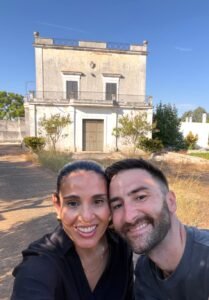
We’re Tim and Celsa. We’re both originally from London, Celsa with her deep Italian heritage, and me with a camera usually glued to my hand. Three years ago, we made the big move across the world to live in Australia.
Today, Celsa works as a solicitor, and I work as a destination wedding photographer splitting my time between Australia and European summers in Italy.
Despite living in Melbourne for most of the year, Southern Italy has always kept a tight pull on us. Celsa’s family has been coming back to Puglia every summer for 25 years, so when the opportunity came up to step in and keep an original 19th-century masseria in the family, we jumped in with both feet.
Our Piece of History: The Aurisicchio Legacy
While we don’t know the exact year our masseria was laid, we know it dates back to the 1800s and was originally owned by a noble family named Aurisicchio.
Right at the front facade of the main building, carved prominently into the stone, is the original family crest: two lions facing each other over a water well. It’s weathered and needs some careful maintenance, but restoring that crest and preserving the history carved into it is one of our favorite little projects on the horizon.
Looking around the ground floor, you can immediately see how the building functioned. Downstairs in what will eventually be our living room, you can still see the original stone feeding troughs built into the walls where horses or cattle were kept.
Our goal is to bring the masseria back to life gently. We aren’t building crazy modern extensions or gutting the soul out of the space. We want to restore the beauty that’s already here, design a traditional Puglian garden directly surrounding the house, and let the historical stone speak for itself.
Working with the Land
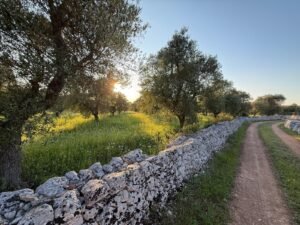
The house sits on two hectares of land filled with old olive trees. Keeping that agricultural connection alive is a massive priority for us, but it’s definitely not without its hurdles.
If you know anything about Puglia right now, you know that olive groves across the entire region are facing a devastating bacterial disease called Xylella. Managing two hectares of land means we’re having to figure out how to navigate that reality firsthand, whether that means trying to protect our current trees or making tough decisions about what comes next.
We’ll be diving deep into the reality of Puglia’s olive tree disease, what it means for landowners, and what we’re planning to do with our grove in our next post!
Thanks for following along as we figure out this restoration step by step. More updates coming very soon!