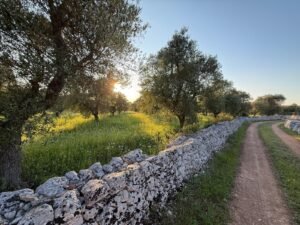
When you imagine the Puglian countryside, your mind instantly fills in the picture: endless red soil, dry stone walls, and thousands of ancient, silver-green olive trees stretching out toward the sea.
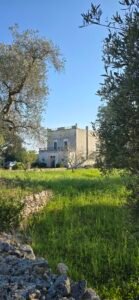
When we bought Masseria Le Camere, the two hectares of olive land surrounding the stone house were a massive part of the dream. But owning land in Puglia today means inheriting a very real, very complex challenge that has been quietly reshaping the entire region for over a decade.
If you’ve spent any time in Southern Italy recently, you’ve likely heard the word spoken in hushed, heavy tones: Xylella.
A Disease Moving North
For anyone unfamiliar, Xylella fastidiosa is a plant bacterium transmitted by small sap-feeding insects. It effectively clogs the tree’s water-transporting vessels, causing the leaves to dry out, branches to wither, and eventually, the tree to die.
It started over a decade ago down in the south of the region, around Salento, leaving vast swathes of dead, grey olive groves in its wake. Over the years, it has slowly, systematically worked its way north through Puglia.
When you drive through the countryside around Ostuni now, you can see the creeping edge of that wave. On our own two hectares, we’re starting to see those early signs ourselves, isolated branches here and there with dried, brown leaves brittle against the sun. It’s a sobering sight, and to be honest, it feels almost inevitable.
Heartbreak for the Local Community
When we first realized our grove was showing symptoms, our initial reaction was a mix of sadness and confusion. But as we’ve talked to local neighbors, agronomists, and farmers, our perspective quickly shifted.
For us, the loss of olive trees is mostly aesthetic and emotional. It’s a heartbreak, absolutely, but our livelihoods don’t depend on harvest yields. For local farming families who have worked this land for generations, Xylella is a complete tragedy.
It doesn’t just strip away a farmer’s ability to produce olives and make a living from olive oil, it decimates the actual value of their land. A parcel of land filled with healthy, producing olive trees holds a value and a legacy that simply disappears when those trees are gone.
Across the region, everyone is handling the crisis differently:
- The Traditionalists: Trying everything possible to treat, prune, and save the original trees for as long as they can hold out.
- The Adaptors: Replanting with newer, disease-resistant olive varieties like Favolosa or FS-17.
- The Diversifiers: Pivotting away from olives entirely to trial new crops like almonds, pomegranates, or figs.
- The Resigned: Deciding that after years of uncertainty, it’s simply time to sell up.
What It Means for Our Grove
When you start asking around for advice, you quickly realize how much of a learning phase everyone is still in. We’ve been told everything under the sun—from elaborate organic soil treatments and drastic pruning methods, to blunt advice that there’s no cure and we just need to pull them out.
It’s an issue we honestly didn’t fully grasp when we took on the house, but we’re learning as fast as we can.
Right now, our plan is still somewhat up in the air, but we’re leaning toward a gradual transition. The reality of Xylella is that it rarely kills an ancient tree overnight; it can take years for a grove to slowly decline. Rather than fighting an impossible battle or waiting for the land to go completely bare, we’re looking at replacing affected trees in stages over the next few years.
Finding Solutions & Moving Forward
It’s hard not to feel a deep sense of grief for the community and for the historic, thousand-year-old trees that have stood as silent witnesses to Puglian history for centuries. Walking past a ancient trunk that took eight hundred years to grow, knowing it likely won’t survive the decade, is tough to swallow.
But at a certain point, once you’ve mourned what’s being lost, you have to focus on what comes next. Puglia’s landscape has evolved through countless centuries, and the resilience of the people here is incredible.
Our job now is to listen to local experts, figure out how we can responsibly care for our two hectares, and play a small part in rebuilding the land for the future—whatever that new landscape looks like.
We’ll keep sharing updates on how our grove progresses, what advice we get from local growers, and how we tackle the replanting process on site!